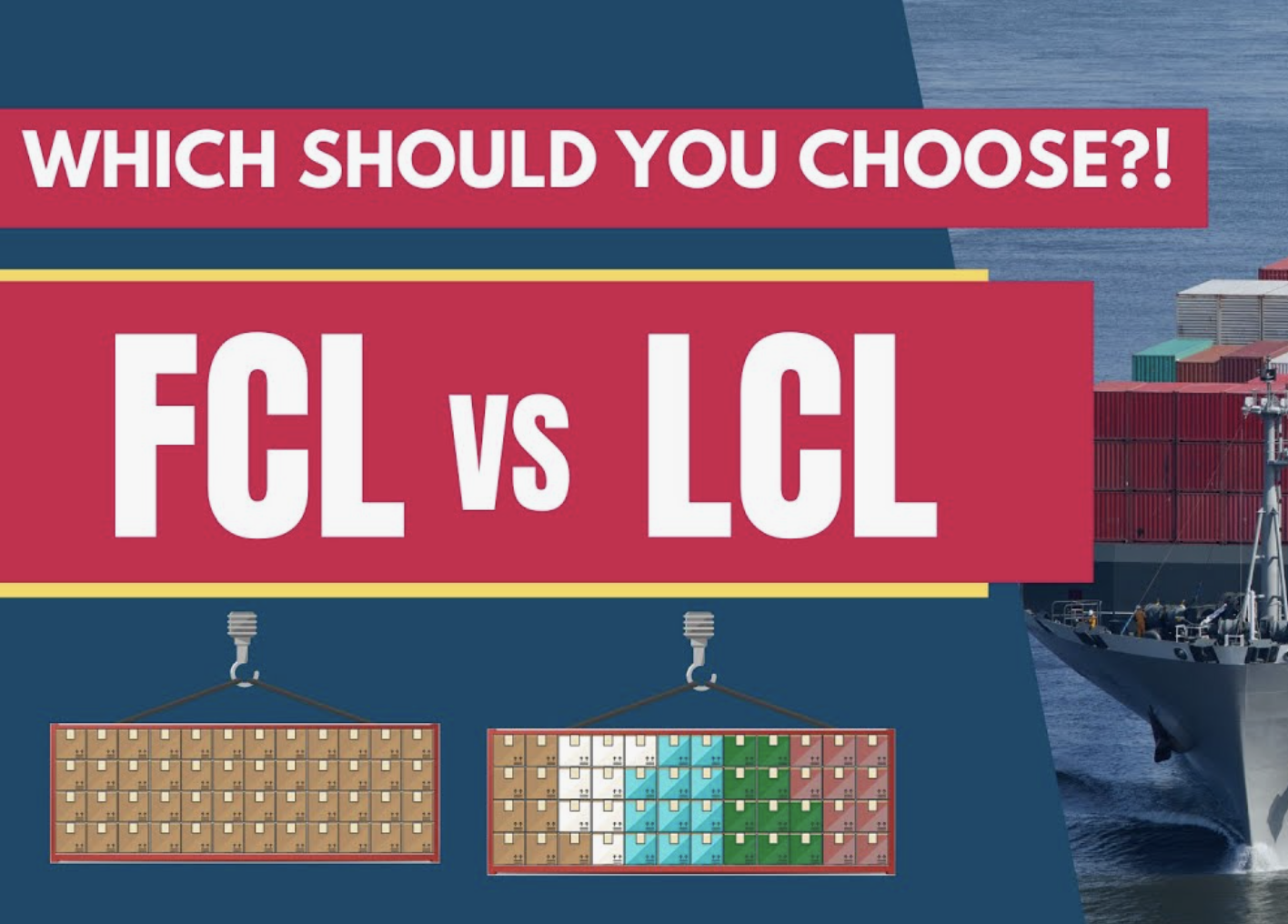
What are LCL and FCL? Complete Guide
If you’re stepping into the world of international shipping, the terms FCL and LCL are two of the first things you’ll encounter. At first, they might sound like confusing shipping jargon, but understanding the difference between them is crucial for making cost-effective and time-saving decisions when importing or exporting goods.
Imagine you’re planning to ship products overseas, but you’re unsure whether your goods will fill an entire shipping container. Should you book the whole container (FCL), or should you share it with others (LCL)?
This guide will walk you through everything you need to know about FCL (Full Container Load) and LCL (Less than Container Load) shipping methods—explained in simple, beginner-friendly language.
Whether you’re a small business owner, a first-time importer, or just someone curious about how the global supply chain works, this comprehensive guide will help you make an informed decision and avoid common pitfalls.
Table of Contents
Understanding the Basics of LCL and FCL
What is FCL (Full Container Load)?
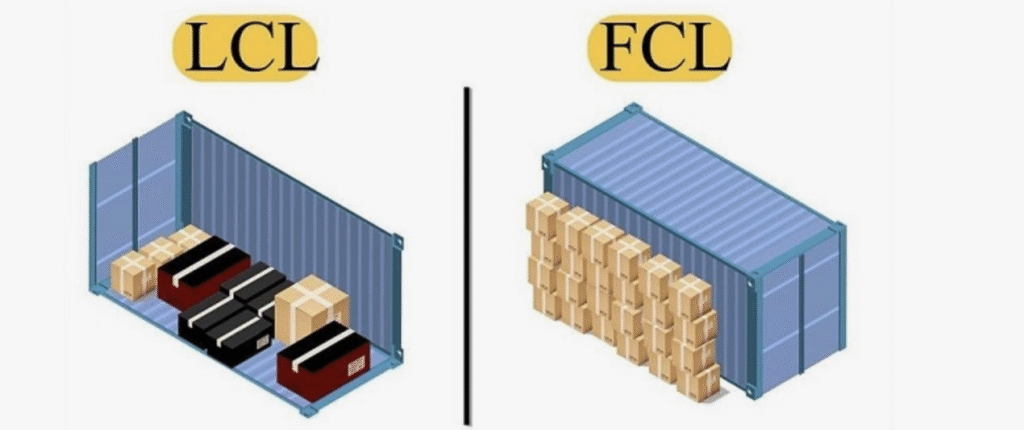
FCL stands for Full Container Load, which means you’re renting and using an entire container exclusively for your shipment. No one else’s goods are packed with yours. Think of it like renting a whole moving truck—you control what goes in, how it’s loaded, and when it moves.
FCL is usually the go-to option for larger shipments. For example, if you’re importing 10,000 pairs of shoes from Vietnam to Los Angeles, it might make sense to get your own container. You’ll avoid sharing space with others and reduce the chances of delays or damage caused by handling mixed goods.
Key features of FCL:
- Exclusive use of container space.
- Typically more cost-effective per unit when shipping high volumes.
- Lower risk of contamination or damage from other shipments.
- Often faster due to reduced handling and fewer stops.
FCL comes in various container sizes, with 20-foot and 40-foot containers being the most common. A standard 20-foot container holds about 33 cubic meters, while a 40-foot container holds around 67 cubic meters.
What is LCL (Less than Container Load)?
LCL, on the other hand, stands for Less than Container Load. This method is ideal when your shipment doesn’t fill an entire container. Instead of paying for unused space, your cargo is consolidated with shipments from other customers heading to the same destination.
Using the moving truck analogy again, LCL is like renting a portion of a truck shared with other people. While it’s cost-effective for smaller loads, it comes with a few compromises—like delays due to consolidation and higher chances of mishandling due to frequent loading and unloading.
Key features of LCL:
- Pay only for the space you use (measured in cubic meters).
- Perfect for small to medium-sized shipments.
- Consolidation and deconsolidation increase transit time.
- Higher handling risks due to mixing of goods.
LCL is widely used by small businesses that can’t yet fill an entire container or want to test a new product in the market before committing to bulk shipping.
Key Differences Between FCL and LCL
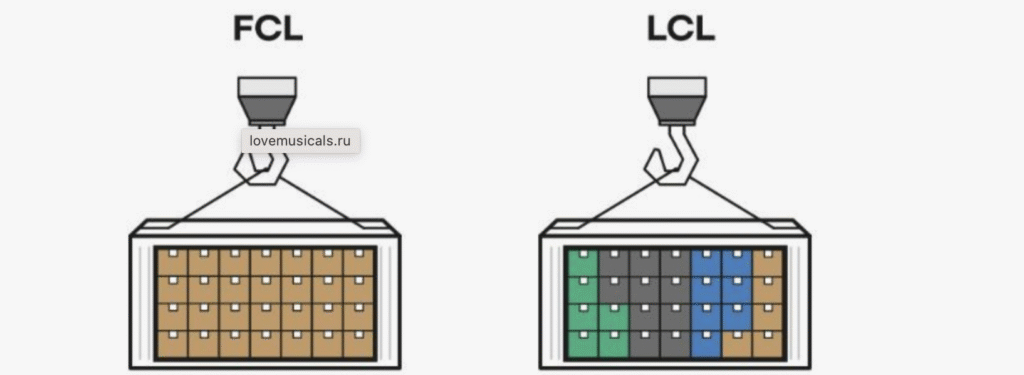
Understanding the fundamental differences between FCL and LCL is crucial before making a shipping decision. These two modes of ocean freight may serve the same purpose—transporting goods from one port to another—but they operate in distinct ways that impact cost, time, safety, and logistics. Here’s a breakdown of the main differences every beginner should know.
Ownership of Container Space
One of the most obvious distinctions is who owns the container space during the shipment. In FCL, the entire container is yours. You’re the only one whose cargo is inside, and you have complete control over how it’s packed and sealed. No one else touches your stuff until it arrives at its final destination. This level of exclusivity offers both security and simplicity.
In contrast, with LCL, your cargo shares the space with multiple shipments from different customers. This means your goods are packed alongside others that may have completely different handling requirements. As a result, there’s more potential for cross-contamination, damage, or even customs complications.
Example:
- FCL = Renting an entire apartment for yourself.
- LCL = Renting a room in a shared apartment.
If your shipment is fragile or sensitive in any way, FCL gives you peace of mind that LCL simply can’t match.
Shipping Costs and Pricing Structure
When it comes to pricing, FCL and LCL follow very different models. FCL has a flat-rate pricing structure—you pay for the whole container, whether it’s full or half-empty. This might sound expensive at first, but if your shipment volume is high enough, the cost per unit is significantly lower than LCL.
LCL, on the other hand, charges you based on the volume or weight of your cargo—whichever is higher. While this makes it cost-effective for smaller shipments, it can become pricey as volume increases. And there are often hidden costs in LCL, such as consolidation fees, deconsolidation fees, handling charges, and documentation expenses that can quickly add up.
Cost Tip: If your shipment is over 13-15 cubic meters, FCL may be cheaper than LCL. Always ask your freight forwarder to quote both options for comparison.
Transit Times
FCL is generally faster. Why? Because the container is loaded directly onto the vessel and shipped straight to the destination without the need for consolidation or deconsolidation. The handling is minimal, and customs clearance is smoother since only one shipper is involved.
With LCL, transit time is extended because your shipment goes through multiple stages:
- Consolidation with other cargo at the origin port.
- Possible stops along the way for additional cargo pickup or drop-offs.
- Deconsolidation at the destination port.
- Extra inspection time during customs clearance.
These added steps can delay your shipment by a few days to even a couple of weeks, depending on the region and the freight forwarder’s efficiency.
Handling and Risk of Damage
The more your goods are handled, the greater the chance of something going wrong. LCL shipments are handled at least twice more than FCL: once during consolidation and again during deconsolidation. Each touchpoint increases the risk of breakage, misplacement, or exposure to external elements.
FCL, with its sealed container, ensures that your shipment remains untouched from the time it leaves your warehouse until it arrives at its destination. This makes it the preferred method for high-value or delicate cargo.
If you’re shipping electronics, furniture, artwork, or anything fragile—FCL should be your top choice.
Customs Clearance Processes
In FCL shipments, the customs process is usually quicker and more straightforward. Since there’s only one set of documents, customs officers can inspect and clear the container more efficiently.
LCL customs clearance, however, can be complicated. If any shipment within the container has documentation issues or is flagged by customs, the entire container may be held up. This means even if your paperwork is flawless, you could still face delays due to someone else’s mistakes.
Pro Tip for Beginners:
If you’re planning regular shipments or foresee your business growing quickly, start exploring FCL options sooner rather than later. It’s a long-term strategy that pays off in cost, security, and efficiency.
When Should You Choose FCL?
Choosing FCL makes sense when your shipment volume is large enough to fill a significant portion of the container, typically around 13-15 cubic meters or more. Even if you’re not completely filling it, the benefits in speed, security, and simplicity might justify the extra cost.
But there’s more to consider than just volume. Let’s walk through the top reasons why FCL might be the better choice for you.
Volume Consideration
Volume is king in FCL. Once your shipment crosses a certain volume threshold, FCL becomes not just an option—but the more cost-efficient one. This is because the cost per cubic meter drops drastically when you use the entire container.
Let’s break it down:
- A 20-foot container holds about 33 cubic meters.
- If you’re shipping 15+ cubic meters, you’re already using almost half the space.
- At this point, you’re paying nearly as much for LCL as you would for the full container.
So, if your shipment is bulky, heavy, or consists of many units, you should start considering FCL right away.
Security and Privacy
With FCL, you’re the sole occupant of the container, which means:
- No risk of your goods being damaged by someone else’s cargo.
- No contamination from incompatible products (like chemicals or perishables).
- Full control over how your items are packed and arranged.
This level of container integrity is invaluable if your goods are sensitive or valuable.
Cost Efficiency for Large Shipments
The flat-rate pricing of FCL starts to work in your favor once you reach a certain volume. Even though the initial quote might be higher, the per-unit shipping cost becomes cheaper as your shipment fills more of the container.
Also, FCL often incurs fewer handling and port fees compared to LCL. Since your container goes directly from ship to port and then to you, there are fewer middlemen and lower risks of surprise charges.
Examples When FCL Is Ideal:
- A furniture exporter sending 200 chairs from India to Australia.
- An electronics supplier moving high-value tech equipment from Taiwan to Germany.
- A clothing brand importing seasonal inventory in bulk from Bangladesh.
Still unsure if FCL is for you?
Talk to your freight forwarder and request a cost-volume comparison. It’s a standard part of the job, and it could save you thousands in the long run.
When Should You Choose LCL?
LCL (Less than Container Load) is the go-to choice for many small businesses, startups, and solo importers. It’s flexible, relatively affordable for lower volumes, and allows you to ship internationally without needing to commit to an entire container. But while it has its advantages, LCL also comes with some important caveats beginners need to understand before jumping in.
Let’s break down when and why LCL might be the right option for you.
Lower Volume Shipments
This is the #1 reason to go with LCL. If your shipment doesn’t fill at least 13 to 15 cubic meters, FCL might not make sense financially. LCL gives you access to international freight without the pressure of large minimum volumes.
Here are a few common examples of low-volume use cases:
- A startup importing 200 pairs of handmade shoes from Vietnam.
- An Etsy shop sourcing 15 boxes of hand-woven textiles from Morocco.
- A small bookstore shipping 1 pallet of rare books from the UK to the US.
In these cases, the cost of FCL would be excessive relative to the cargo value. With LCL, you only pay for what you use—typically calculated in CBMs (Cubic Meters).
Cost Sharing with Other Importers
Think of LCL like carpooling for your cargo. You split the space, and therefore the cost, with other shippers. This makes LCL especially attractive if you’re still testing the waters of international trade or if your cash flow doesn’t yet support bulk imports.
However, remember:
- While the base rate may look low, LCL often involves extra fees like consolidation, documentation, and deconsolidation charges.
- Some forwarders even charge minimum fees if your cargo is under a certain size, so always ask for a full cost breakdown before you commit.
Increased Handling and Its Impact
The trade-off for affordability is that LCL shipments go through multiple touchpoints:
- Consolidation warehouse at the origin.
- Loading onto the container with other cargo.
- Arrival at destination port, followed by deconsolidation.
- Release to final consignee (that’s you!).
This process adds time, increases handling risks, and often leads to delays. Your goods might be held up if another shipper in your container has issues with documentation or customs. Unfortunately, in LCL, your shipment’s fate is tied to everyone else’s in that container.
That said, if your goods aren’t time-sensitive or fragile, the risks are manageable—especially when working with a reputable freight forwarder.
Best-Use Scenarios for LCL:
- New product testing with small quantities.
- First-time importers with limited budgets.
- Seasonal or niche items with low volume.
- E-commerce sellers looking to diversify inventory.
What to Watch Out For with LCL:
- Hidden Fees: Ask for a detailed breakdown.
- Packaging Requirements: Improper packaging leads to damage.
- Longer Transit Time: Expect 5–10 extra days depending on the route.
- More Paperwork: Multiple shippers = more documentation.
Pro Tip:
Always ensure your goods are well-packaged and clearly labeled. Since your cargo will be handled multiple times during the journey, good packaging can make the difference between safe delivery and a customer complaint.
Cost Comparison: FCL vs LCL
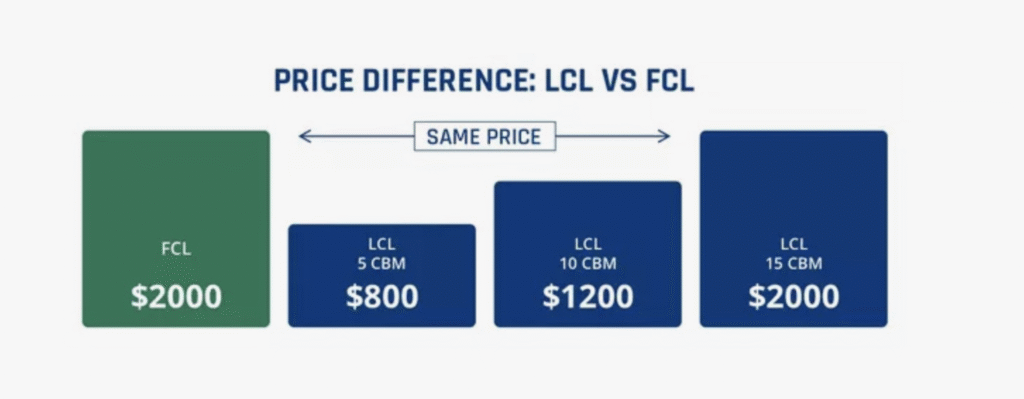
When it comes to international freight, cost is usually the deciding factor for beginners. While LCL may seem cheaper on the surface, there’s more to the story. FCL can actually be the better deal if you crunch the numbers properly. Let’s break down how costs compare between the two.
Fixed vs Variable Pricing
FCL has fixed pricing. You pay for the container, whether you fill it to the brim or only halfway. The good news? That makes it predictable. If you know your volume and weight, your quote will usually be close to your final bill.
LCL, by contrast, uses a variable pricing model. You pay per CBM or per 1,000 kg—whichever is greater. Then come the additional charges:
- Consolidation fees
- Deconsolidation fees
- Destination port charges
- Handling and documentation fees
These extra costs can make LCL surprisingly expensive, especially if you’re shipping around 10–15 CBM, which is close to the break-even point where FCL becomes more affordable.
Break-even Poin
The break-even point is the shipment volume at which LCL and FCL costs are roughly equal. Most freight experts agree this happens at 13 to 15 CBM. Beyond that, FCL almost always provides better value.
Here’s a simple chart for reference:
| Shipment Volume (CBM) | Recommended Option |
|---|---|
| 1–8 CBM | LCL |
| 9–12 CBM | Depends – Compare both |
| 13+ CBM | FCL |
Example Pricing Scenarios
Let’s say you’re shipping from Shanghai to Los Angeles.
LCL:
- Cargo Volume: 10 CBM
- Rate: $30/CBM
- Base Cost: $300
- Handling Fees: $150
- Destination Charges: $200
Total: $650
FCL:
- 20’ Container Rate: $950
Total: $950
At 10 CBM, LCL is cheaper by $300—but once you reach 13–14 CBM, FCL often becomes the better deal, especially when you factor in security, speed, and fewer surprise fees.
Pro Tip:
Ask your freight forwarder for quotes on both FCL and LCL when your shipment is borderline. The cost difference may be negligible, but the convenience and reliability of FCL could make it worth the upgrade.
Transit Time: FCL vs LCL
Transit time can make or break your supply chain—especially if you’re trying to meet customer demand, hit seasonal deadlines, or avoid costly inventory delays. While both FCL and LCL shipments travel on the same vessels across oceans, the time it takes for your goods to get from point A to point B can be dramatically different depending on the shipping method.
Let’s explore the factors that impact transit time and why FCL generally comes out ahead.
Direct Routes vs Consolidation Delays
FCL shipments are loaded directly into a container at your supplier’s warehouse, sealed, and shipped straight to you. That means no stops, no mixing with other cargo, and no delays waiting for space to be filled. Once the container is ready, it goes directly to the port, gets on the vessel, and sails to your destination.
In contrast, LCL shipments have to be consolidated with cargo from multiple shippers. This extra step at the origin adds anywhere from 2–7 days before your shipment even leaves port. And once it arrives, the container has to be deconsolidated, which adds another 2–5 days depending on how efficient the freight forwarder is.
So while the sea transit time may be the same (say, 15 days from Shanghai to LA), the total door-to-door time could look like this:
| Step | FCL | LCL |
|---|---|---|
| Pickup & port delivery | 1–2 days | 1–2 days |
| Consolidation | – | 2–5 days |
| Ocean transit | 15 days | 15 days |
| Customs & unloading | 2 days | 3–6 days |
| Deconsolidation | – | 2–5 days |
| Total Time | ~18–20 days | ~23–28 days |
If your shipment is time-sensitive, the difference between 20 days and 28 days could cost you money in stockouts or missed sales opportunities.
Customs and Documentation Timeframes
FCL is usually faster at customs. Why? Because the documentation is straightforward—one shipper, one consignee, one set of documents. If the paperwork is in order, your container can be cleared in a matter of hours or a day.
With LCL, the complexity increases. Customs has to process multiple consignments within the same container. If just one shipment has missing documents, unpaid duties, or gets flagged, the entire container may be held. That means everyone in that container waits—even if their paperwork is perfect.
Port Congestion and Handling Time
FCL containers are typically handled more efficiently at the port, especially if your freight forwarder has pre-booked everything in advance. LCL shipments, on the other hand, can face bottlenecks during the deconsolidation phase, especially in busy ports like Los Angeles, Hamburg, or Singapore.
Also, larger LCL warehouses may have scheduling delays, particularly during peak shipping seasons (October–December). So even if the ship arrives on time, your cargo might sit in a warehouse for days before it’s sorted and released.
Pro Tip for Faster Shipping:
- For LCL, always use a reputable freight forwarder with a reliable consolidation network.
- For FCL, pre-clear customs while your shipment is in transit to minimize delays on arrival.
Space Utilization and Packing
How you use your container space can drastically affect your shipping efficiency, especially if you’re paying for the full container (FCL) or getting charged by volume (LCL). Whether you’re shipping bicycles, books, or bar stools, optimizing packing can save you thousands in freight costs.
Container Types and Sizes
There are two main types of containers used in ocean freight:
- 20-foot container (20’ GP):
- Approx. 33 CBM (Cubic Meters)
- Suitable for heavier, denser goods (e.g., tiles, metals)
- 40-foot container (40’ GP):
- Approx. 67 CBM
- Better for lighter, voluminous items (e.g., furniture, pillows)
Other variations include:
- 40’ HQ (High Cube): Extra height, about 76 CBM
- Reefer containers: For perishable goods
- Open top/flat rack containers: For oversized machinery
How Efficiently Goods Are Packed
FCL allows you to customize the packing of your container. You can arrange boxes, pallets, or crates in a way that minimizes unused space. This level of control ensures:
- Fewer damaged goods
- Faster loading and unloading
- Lower per-unit shipping cost
LCL shipments, on the other hand, are packed into shared containers. Your goods are loaded according to warehouse protocol—not necessarily for maximum efficiency. Also, some space is “lost” due to pallets, packaging buffers, or gaps between shipments.
Tips for Maximizing Container Space
- Use Pallets Wisely: Pallets protect goods, but they also take up space. Consider slip sheets if shipping light goods.
- Go Vertical: Use the full height of the container. Stack boxes smartly to reduce empty air.
- Choose Right Box Sizes: Avoid using boxes that are too large. Wasted space adds up quickly.
- Shrink Wrap & Band: Secure loose items to avoid movement and damage.
- Avoid Overpacking: Exceeding weight limits (especially in 20’ containers) can result in port rejections or heavy fines.
Beginner Mistake to Avoid:
Don’t rely on your supplier to pack smart. Communicate exact dimensions and packing preferences in advance. Better yet, request a packing plan or 3D layout.
Customs and Documentation
Customs clearance can be one of the most intimidating parts of international shipping—especially for beginners. But whether you’re shipping via FCL or LCL, one thing is certain: if your documentation isn’t spot-on, your cargo won’t move.
Understanding how customs works, who’s responsible for what, and how the process differs between FCL and LCL will help you avoid delays, penalties, and unexpected headaches.
Who Handles What in FCL vs LCL
In FCL, you (or your freight forwarder) are the sole party responsible for the entire container. This means:
- One Bill of Lading
- One Commercial Invoice
- One Packing List
- One Consignee
- One set of duties and taxes
This simplicity allows for quicker customs clearance, as there’s no confusion about who owns what or who’s responsible for the documentation.
In LCL, however, multiple shippers’ cargo is combined into a single container. The freight forwarder handles the master Bill of Lading, but each individual shipment has its own House Bill of Lading and associated documents. This added complexity introduces more chances for error.
If one party’s paperwork is incomplete or inaccurate, the entire container may be held at customs until the issue is resolved.
Documentation Checklist
Here are the key documents required for both FCL and LCL shipments:
| Document | Purpose |
|---|---|
| Commercial Invoice | Details the transaction between buyer and seller |
| Packing List | Itemizes contents of the shipment |
| Bill of Lading (B/L) | Contract between shipper and carrier |
| Certificate of Origin | States where the goods were manufactured |
| Import/Export Licenses | Required in some countries for certain products |
| Insurance Certificate | Proves shipment is covered against loss/damage |
| Customs Declaration | Filed with destination customs authority |
Note: For LCL, you must also ensure your shipping marks are clear. These identify your cargo among others in the container.
Common Mistakes to Avoid
- Mismatched Information: Details on invoices must match the packing list and bill of lading.
- Undervaluing Cargo: Trying to save on duties by declaring a lower value can lead to audits or penalties.
- Missing Import Licenses: Some goods require permits—always check your destination country’s regulations.
- Inaccurate HS Codes: The wrong Harmonized System code can delay clearance or increase duty rates.
- Failure to Pre-clear: Start customs clearance before the shipment arrives to save time.
Pro Tip for Beginners
Use a freight forwarder who offers customs brokerage services. They’ll help you navigate the maze of regulations, file documents correctly, and deal with customs authorities on your behalf. Some even bundle customs clearance into your overall freight quote.
Real-World Scenarios
Sometimes theory isn’t enough—you need to see how all of this plays out in the real world. Let’s look at a couple of beginner-friendly case studies that illustrate how choosing FCL or LCL can impact your shipping strategy.
Case Study: Small Business Shipping via LCL
Scenario: A startup coffee brand in Canada wants to import 1,000 bags of specialty coffee beans from Colombia. The total shipment volume is about 6 CBM.
Decision: They go with LCL.
Why?
- Their volume doesn’t justify an FCL.
- Their budget is tight.
- They don’t mind a few extra days in transit.
Outcome:
- The cargo is consolidated with other shipments heading to Toronto.
- Total shipping cost: $650
- Delivery takes 26 days.
- Minor delays at deconsolidation, but everything arrives intact.
Lesson Learned: LCL is great for testing suppliers and market demand without a big upfront investment.
Case Study: Large Retailer Using FCL
Scenario: A mid-sized home decor company in Australia is importing a full season’s worth of inventory from Vietnam—about 28 CBM of goods.
Decision: They choose FCL and rent a 20-foot container.
Why?
- The volume is near full capacity.
- The products are fragile.
- They need to meet tight delivery windows before peak season.
Outcome:
- The shipment is loaded and sealed at the supplier’s factory.
- It clears customs within 48 hours.
- Delivered directly to their distribution warehouse in Sydney.
- Total shipping cost: $1,200
- Delivery takes 19 days.
Lesson Learned: FCL provided a faster, safer, and more cost-effective shipping experience due to high volume and time sensitivity.
Choosing the Right Freight Forwarder
Your freight forwarder can make or break your shipping experience. Especially as a beginner, you want a partner who understands your needs, communicates clearly, and can guide you through the process from start to finish.
What to Look For
- Experience with FCL and LCL: They should know when to recommend each.
- Global Network: Strong connections in both origin and destination countries.
- Transparent Pricing: No hidden charges. Clear cost breakdowns.
- Customs Expertise: Can handle documentation, filing, and clearance.
- Responsive Customer Service: Answers emails and calls quickly—especially if issues arise.
How They Handle FCL vs LCL
A good forwarder will:
- Provide cost comparisons between FCL and LCL.
- Suggest the right container size or consolidation warehouse.
- Pre-clear customs to avoid delays.
- Help you prepare accurate paperwork.
They’ll also offer value-added services like:
- Cargo insurance
- Packaging recommendations
- Real-time tracking
- Door-to-door delivery
Questions to Ask Before Hiring a Freight Forwarder
- How many FCL/LCL shipments do you handle each month?
- Can you help with customs clearance at both ends?
- What’s your process for tracking delays or damages?
- Do you offer cargo insurance?
- Can I get references from other clients?
Pro Tip:
Don’t just go for the cheapest quote. In freight, you often get what you pay for. The right forwarder is your partner—not just a vendor.
Conclusion
When it comes to international shipping, the choice between FCL (Full Container Load) and LCL (Less than Container Load) isn’t always black and white—especially for beginners. Each method offers its own unique set of advantages and trade-offs, and the right decision depends on your shipment volume, budget, timeline, and risk tolerance.
If you’re shipping large volumes, have tight delivery schedules, or need greater control over your cargo, FCL is often the smarter route. It’s faster, more secure, and cost-efficient per unit once you hit that 13–15 CBM threshold. You get your own sealed container, fewer touchpoints, and generally less hassle at customs.
On the flip side, if you’re starting out small, testing the market, or only moving a few CBMs of cargo, LCL provides the flexibility and affordability you need. It allows you to dip your toes into global trade without the commitment of a full container. Yes, it’s a little slower and riskier, but with the right freight forwarder and solid packaging, it’s a viable option for many first-time shippers.
The key takeaway? Know your numbers, understand your cargo, and work with a freight partner who has your back. Ask for quotes for both options. Compare transit times. Always factor in hidden costs and the value of your time and peace of mind.
Remember: every container tells a story. Whether it’s shared or solo, what matters most is that your shipment arrives safely, on time, and within budget.
FAQs About LCL and FCL

Is FCL always faster than LCL?
Yes, in most cases. FCL avoids consolidation and deconsolidation processes, which adds time to LCL shipments. FCL containers are sealed at origin and go directly to the destination.
Can I switch from LCL to FCL mid-shipment?
No. Once your cargo is booked and consolidated for LCL, it can’t be switched mid-shipment. However, you can choose FCL for future shipments as your volume grows.
What is the minimum volume for FCL?
There’s no official minimum, but it becomes cost-effective around 13–15 CBM. Below that, LCL is typically cheaper. That said, FCL may still be worth it for fragile or high-value goods.
How do I calculate if my shipment is LCL or FCL?
Measure the total volume (in CBM) and weight of your goods. If the volume exceeds 13 CBM, request quotes for both LCL and FCL from your freight forwarder to compare.
Do shipping lines offer both FCL and LCL?
Shipping lines typically only offer FCL. LCL services are handled by freight forwarders or consolidators who combine cargo from multiple shippers into a full container.